Showing posts with label mass behavior. Show all posts

Thursday, November 11, 2010

Oklahoma Asks, and Answers, a Sucky State Question


Voters are fairly stupid—I think that’s been established. Maybe individually they know what they’re doing: They own landscaping companies and know where the good pizza places are and read the paper and do the Sudoku every day, even on Friday when it gets really hard. But something happens when they get to the voting booth, with those old-fashioned curtains and the ballot that seems more complicated than it needs to be. They freeze up. Who are these judges on the ballot? What’s the “anti-prohibition” party? What the fuck are all these measures I’ve never heard of? Panic sets in. Some circles are filled in, there’s a momentary anxiety that they filled in the circles wrong, the voter realizes they might have voted for the wrong judge, but it’s too late to fix it now. Then they get outside and they’re smart again.

That’s the only explanation I can think of for the passing of Oklahoma’s State Question 755, which amends the state constitution to ban judges from considering “international or Sharia law” when making rulings. Because damn, that is a stupid amendment. It wasn’t as if a bunch of judges were commanding hands to be chopped off and whores to be stoned. I’ve never been to Oklahoma, but I’m pretty sure that Islamic law is about to be instituted there. And the UN isn’t about to take control of the state either.

I’m sure the voters saw that measure on the ballot and said, “Well, better safe than sorry. I really don’t want to see strict Sharia law imposed on me, although it would give me an excuse to grow out my beard.” That’s like amending the constitution to say, “If aliens ever attack Earth, like in Independence Day or that new movie that looks almost exactly like Independence Day, we are totally going to fight back, like Jeff Goldblum and Will Smith.” A fine sentiment, but not something that needs to be in a constitution.

The problem is the anti-Sharia amendment could create difficulties due to vague wording and the general craziness of it. Indian tribes say they’re worried that Question 755 might invalidate their tribal laws, and international law is actually kind of important when resolving disputes between companies in Oklahoma and their overseas business partners. (Who knew international law governed international trade?)

Question 755 will probably get challenged in the courts and likely overturned (it might violate the ever-pesky First Amendment by singling out Sharia). So it’s likely just another example of xenophobic paranoia from the heartland that sounds good on paper but in reality is not a good idea, or even an idea at all, much like the Republican proposal to save money by cutting nonexistent social programs isn’t an idea. It’s fun, and sort of funny, to yell and make laws about problems that do technically not exist, but maybe we have better things to do. Do we? Read more!

Tuesday, November 2, 2010

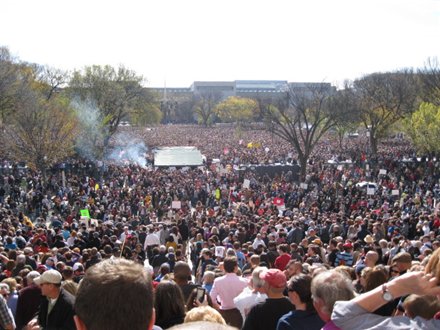
Man, That Sucked: The Rally to Restore Sanity


I don’t think anyone knew how big it was going to be. Arianna Huffington definitely didn’t. She generously offered to transport the sum total of New York’s liberati—signs, costumes, iPhones and all—from one baseball stadium parking lot to another in what ended up being 200 buses.

I actually saw Arianna herself while I was waiting in the freezing early October morning. She was surrounded by a bubble of people filming her with digital phones and camera and moving through the shivering, huddled masses like I imagine French aristocrats used to do, smiling and waving as if she was totally used to being surrounded by admirers at six in the morning. “Thank you!” some of the masses yelled at the queen bee of the bloggers.

Those thanks would seem somewhat premature hours later, as it became apparent how late to the rally we all would be. The plan was for everyone to show up at Citi Field (nee Shea Stadium) at 5:30 am and for the buses to leave at 6:00. This did not happen. Instead, 10,000 people stood around in a gigantic swarm for two hours shifting from foot to foot and wondering what the hell was going on. When the group of people surrounding me finally got within sight of the idling buses they finally snapped and ran through the yellow police tape like refugees fleeing across a border. “Come on! Let’s be adults!” a Huffington Post volunteer shouted through a megaphone. But fuck that—our hands were numb and the buses, the warm, warm buses, were right there.

When we were actually on the bus, half-asleep and half seized with that dumb earnest glee that afflicts the young and politically active on their way to a protest, the human gridlock of Citi Field seemed like a bad dream. We drove along the Brooklyn Queens Expressway while those boroughs were sluggishly waking up to the weekend, then switched to the great emptiness bordered by factories that is the New Jersey Turnpike. I woke up from a nap with my head against the window and discovered the highway surrounded by an astonishing wall of trees in the middle of changing colors—impressionistic swaths of yellow and red that make you forget there’s such a thing as a 24-hour news network. That was the high point of the trip.

The low point came about five minutes after we staggered off the bus in DC, when it became apparent that DC’s Metro wasn’t going to be able to accommodate tens of thousands of people all trying to get to the same place. The underground station was packed wall-to-wall, floor-to-ceiling with out-of-towners hopelessly trying to figure out how to use the machines. A couple of transit workers kept telling people to step aside, to make room, but how was that going to happen? There was no empty space of tile to step aside to. The rally itself, by the way, had been going on for maybe an hour at this point, and the New Yorkers—tired, hopped up on rest stop coffee, and sneering at DC’s pathetic excuse for a mass transit system—were nervous about missing…

Wait, missing what? What the fuck were we even there to see? A half-dozen comedians pretending to be—or mocking—newscasters or politicians, or something? The Roots and John Legend playing in a venue with terrible acoustics? A bunch of smug liberals smugly parading their liberalism and their predictably ironic signs? After getting three hours of sleep, waking up in the middle of the night, and taking two subways and a bus over the course of a nine-hour trip, did I even know why I’d come?

Clearly not. You have to be willing to suspend your cynicism for a few hours to get involved in a political event like this. You have to believe in the power of the people, that signs and slogans can influence policy, that a bunch of blue-staters getting together will change anyone’s mind about anything. Because otherwise what we have is just the world’s largest and most boring Halloween party, with strangers milling about and taking picture’s of each other’s jokey signs, most of which were all about the futility of signs. “SIGN” said one of them. “MEH” said another.

Worse than the ironic signs were the earnest ones. It was supposedly—according to Stewart, anyway—a “non-political” rally, but anti-Tea-Party and anti-Fox-News messages abounded. A fresh-faced volunteer from Media Matters asked me to sign a petition against Fox News with the ultimate goal, I guess, of forcing them and their sociopathic blonde television hostesses off the hair. Other people made puns: Fox News=Faux News; “The only thing we have to fear is FOX itself.” What wit these clever kids have!

As supposedly and convivial as the rally was, the overall message was one of negativity. The Left—at least the bits represented in Washington DC that day—is anti-Fox-News, and anti-Tea-Party, but what are they in favor of? They want certain people not to be elected, but that's about as far as their ideas go. The Tea Party has dominated whatever passes for the “national political conversation” so thoroughly that the candidates they run against almost don't matter. What are the positions of Chris Coons, Christine O'Donnell's opponent? Who cares, as long as he's not that insane woman. These elections are not about pursuing a liberal agenda, but about stopping the conservative agenda, or at least slowing it down. And isn't that kind of a problem?

The Glenn Beck Right has Christian ideals and libertarian ideas, and as bizarre as that mash-up is, at least it gives them a sense of purpose. Ban gay marriage, ban abortion, abolish the EPA, abolish the income tax, build a giant fence along the border, eliminate foreign aid, wrap schoolchildren in flag-colored clothing and allow (force) them to pray in public schools. And repeal the 17th Amendment, for some reason. However contradictory and repugnant you think those goals are, at least they're something to rally around.

The John Stewart Left has—what? Irony? A shield of Not Giving A Shit? A bouquet of opinions on how the current media climate is destroying America? The people on the Left who have actual policy ideas are the people on the “fringe,” the actual Socialists and Communists and Anarchists who want to nationalize health care and probably a bunch of other industries, dramatically increase taxes on the rich and the upper middle class, and (at the very far end of the spectrum) dismantle capitalism itself.
These things will never happen in America, and you're sleepwalking if you think they will. So the people at the rally, no matter how hard they secretly think dismantling capitalism isn't such a bad idea, content themselves with protesting not policy and actual events, but the media's coverage of policy and events. John Stewart's speech was all about not paying attention to the polarizing, often flat-out hateful rhetoric of the talking heads on both ends of the cable news dial, but he didn't say who we were supposed to be paying attention to.

Or that's what I heard Stewart's speech was about after the fact. I didn't actually hear a word he said, or a word anyone said, because I was too far away from the stage. After walking three miles from RFK Stadium to the National Mall (skipping the clusterfuck that was the Metro), I discovered that the Rally to Restore Sanity was half over, and the fenced-in area of grass in front of the stage where the comedy sketches and half-serious speeches were audible was overflowing with people who had arrived hours in advance. I circulated around the edges, getting my sign photographed and sharing the tea I had brought in a thermos. (My personal cause for the day was the tea was a beloved beverage, not a set of political beliefs. I found some kindred spirits in the group advocating for pancakes, french toast, and other breakfast foods.)

There was a big musical number at the end, then the lucky people who had heard and seen whatever was happening on the stage spilled out onto the street, turning several blocks into a human traffic jam. Some people headed for the bars for after-rally drinks, some no doubt took their costumes to Halloween parties, and those of us who had to ride the Huffington Post back to New York began our long trek back to the buses. I assume pretty much everyone at the rally plans to vote today, probably for Democrats who are going to win in a landslide. How many of my fellow sign-holders came from swing districts where their votes would mean something?

I guess we'll find out tomorrow, or the next day, whether or not a larger-than-expected gathering of the Left means that the election will be better than predicted for Democrats. My short answer is no. What the Rally for Sanity taught me was that you can have a large gathering of hundreds of thousands of people without having a coherent message for what that gathering represents--“We don't watch Fox News!” is not good enough. Despite the numbers, it's pretty clear why there's an enthusiasm gap these days between the Left and the Right. The Left thinks the right is sort of a joke and sort of stupid, while the Right thinks the Left are pure evil bent on destroying America. More and more, I'm starting to think exactly the opposite is true.
Read more!

Sunday, May 23, 2010

Sports Sucks at Our Souls


EMBED-We Are Lebron Video - Watch more free videos
The above video is what sports are all about. It's both heartwarming and heartbreaking—a collection of Cleveland “celebrities” who have to be identified by subtitles (like Peter Lawson Jones, the Cuyahoga County Commissioner, who I imagine does very important work) make a plea to LeBron in song form. LeBron James, in case you didn't know, can choose where to play next year, and if he chooses to play somewhere else than Cleveland, the Cavaliers will revert back to being one of the worst teams in the NBA, as they were before the Coming Of LeBron, and Cleveland will once again become a city without any winning sports franchises. Stripped of the half-sung melody, that song embodies the motto of every poor sports fan in Cleveland: “Please stay, LeBron. Please, LeBron, stay!”

But the fans have no control over what LeBron will do, just like they had no control over the selection of the ever-changing, always-inadequate supporting cast he had for the past seven years. Yet a whole lot of Clevelanders are going to be upset when (if) he leaves, or ecstatic if he stays. This is the problem with being a sports fan, this is why people who don't follow sports are mystified by the whole process: why do we choose to be emotionally invested in something we have literally no control over?

I'm not referring to the individual games, which can be frustrating, exhilarating, gut-wrenching, sometimes even fun to watch. The more maddening thing is the larger games that go on outside of the playing field: the free agent markets and the drafts of the various sports, the hiring and firing of the people in the front office who make choices about the players, the politics and economics of constructing new stadiums, the occasional departure of teams from cities—and in LeBron's case, the departure of a player who basically was the entire team. Franchises are affected for years by these decisions (in the case of a team's moving away from a city, they're literally destroyed), and the fans can do nothing about them.

This is worth complaining about because outside of the NFL--where short careers and a salary cap have made it possible for a team to be very bad, then very good, then very bad again in a short number of years—most franchises are mired in a perpetual slump. Baseball teams like the Mariners, Astros, Nationals (nee Expos), Royals, Rangers, Orioles, Giants, Padres, Reds, Brewers Blue Jays, Pirates, and Indians have gone an entire generation without reaching the World Series, and mostly without hope of doing so. It's sort of weird that the Pirates and Royals still have fans, actually. Why subject yourself to lost season after lost season? In the NBA more teams make the playoffs, but only seven teams have won any championships at all in 26 years—and that's because of the aberrational Mavericks-Heat Finals a few years ago. What is a fan of the Kings or the Bucks or the Pacers to do? Your team is just the guys who the real, actually good teams have to beat in order to play each other in the finals.

There's the pain of watching your team lose on the field, and that's bad enough. (My personal low was watching my Mariners, after winning 116 games in the regular season, lose to the Yankees in the 2001 ALCS. It didn't even go seven games.) But how much worse is it to know that your team is definitely going to lose even before they get on the field? Atlanta Hawks fans know this feeling, as do Kansas City Royal fans. Or if they do win one game, you know that it's a fluke, and the season is going to be another forgotten struggle to reach mediocrity. New York Knicks fans know this feeling, as do Seattle Mariner fans like me.

Fans of losing teams can't even claim to be “cursed” as some of the more famous losing teams in history have claimed to be. The reality is that most of the times, teams are bad for a long time because the people managing them are incompetent. The Knicks' Isiah Thomas years are one example (remember when he gave Jerome James all that money?), but less widely known is the case of Bill Bavasi in Seattle. I won't go through the list of bad signings Bavasi made, but you can read about them here, or just start typing his name into Google and “Bill Bavasi worst GM” will appear as a suggestion.

The Mariners finally fired Bavasi two years ago, but becoming a good Major League Baseball team, let alone a consistently good one, takes a long time and a lot of luck, and they aren't a perfectly managed organization by any means—they still believe that Ken Griffey Jr. is a Major League player, for instance. If I have any hope for the Mariners, it's that five years from now they will make the playoffs and probably lose to the Red Sox and then have their best players hired away by the Yankees. And I guess I also hope they don't leave Seattle and then start winning for another city's fans, the way the Thunder (nee Sonics) did. That's not inspiring. Someone once said, “The sports section records man’s accomplishments; the front page has nothing but man’s failures,” a quote that wouldn't be understood by anyone from Seattle, Cleveland, Buffalo, or Kansas City. Our teams fail and fail again, yet we feel bad each time.

If I wanted to make some broad connections between sports and society, I might note that nearly everything, not just the success of our favorite team, is out of our hands. (The Cold War was so terrifying because everyone on the planet might die for basically no reason at all, and without having the chance to escape. The recent financial crisis is upsetting in the same way—you might do everything right, or think you were doing everything right, and you lost your house or your savings anyway.) But let's keep it simple. Being a sports fan means subjecting yourself to years of rooting for the losing side, opening the paper to sad box score after sad box score, and you hope that your team winning a title will balance it all out. Does it? I don't know and I doubt anyone from Cleveland will know any time soon.
Read more!

Wednesday, April 7, 2010

Why Employment Sucks


An interesting one-two punch of widely-covered news stories landed on our collective eyeballs last week: first, the jobs report told us that more people have jobs now, or at least less people have no job; then, a bunch of miners died on the job. There's usually a bit of irony sprinkled on top of tragedy (Romeo & Juliet's ending is kind of funny, for instance), and the coal-black joke here is that those miners would still be alive and above ground if they were unemployed.

Not everyone's job is as bad as being a coal miner, but unless you're one of those lucky people who get money for what they love to do—and those people are fucking few and far between—you hate your job. It might not a particularly emotional hatred right now—you might have hated it at first and then settled into a semi-comfortable rut, like one of those once-passionate, now loveless marriages, only in reverse—but if I asked the majority of people on the planet if they hated their jobs, they would probably pause and say, “No, I don't hate it exactly. Parts of it are very enjoyable. I've had jobs that were a lot worse and if I stay here I can become assistant manager/senior fry cook/the guy who gets to hold the gun and order us around.” Let's face it—you hate your job, and if you don't, you probably should.

Some time ago I wrote a post about the problems with unemployment, but the reason you feel bad when you are unemployed is not that you don't have a job, it's that almost everyone else does. In Modern Capitalism, no one can literally force you to work, but if you don't work you don't have money, which means you are a failure. If you don't have a job, your parents, roommates, and the people you panhandle from will tell you to get one. If you don't have a job, society in general will conspire to make you feel like shit. “Pull yourself up by your bootstraps!” the right-wingers will yell at you, while the left-wingers will try to enroll you in job training programs and reduced-price housing. If you don't have a job for a while, the government will stop sending you checks, advertisers will stop catering to your demographic, and even the bleedingest-hearted liberal will start thinking that maybe some people are lazy and don't deserve to participate in the global economy.

Everyone who tells you to get a job is cynical at best and a raving moron at worst. Jobs are the problem. Jobs rob us of our dignity and the majority of jobs destroy some small part of the planet. For every life-saving surgeon or genuinely good hearted social worker, there's two soldiers willing to fire into a crowd of civilians when ordered, or a pair of cops who just want to bust brown-colored heads. Coal miners only make the news when they die in the mines, but their jobs don't get better when the cameras leave—they're still sweating in the dark caves, prying black rock out of the ground, and contributing to an industry that is slowly filling the sky with smoke. Jobs are the problem, and if you're not part of the problem, you're part of the solution.

If I was a pragmatist, I'd advise everyone to get a job just to put sandwiches on the table and Flaming Lips records in your ears. But pragmatism is horrible and boring. Here's what you should do: if you don't like your job, quit. We probably only get one life, and thanks to “jobs” everyone spends the majority of it doing a series of unenjoyable menial tasks. Fuck that—let's all just quit. If you don't like what you're doing, you should do something else. If you, like the majority of people in the world, can't do something you find enjoyable and rewarding and keep a roof over your head at the same time, there's something wrong with the world's priorities, not your own.

Jobs mean dying in a mine, either all at once, literally, or very slowly, metaphorically. Yet most of us have them, and are glad we do. The alternative of homelessness and abject poverty is even worse. We just need to come up with better alternatives
Read more!

Wednesday, March 24, 2010

Man, That Sucked: The Health Care Debate


The health care debate is over and no one is happy. When Barack Obama was elected the First Black President Of The United States there were literally people celebrating in the streets. Strangers high-fived and hugged each other. The police stood back at let it happen, because there was no threat of violence and this would never happen again. Our president is black. I'm only 23 years old, but that was the first time I can ever remember that happening.

No one is celebrating like that now. The dyed-in-the-wool leftists are grousing about how this bill just forces us to give money to the insurance companies and the conservatives are up in arms about the cost and the “unprecedented” expansion of the federal government. If the election of Obama was a night of emotional, wonderful, soul-merging sex, the process by which HR 3962 got passed was a drunken, coke-fueled one-night stand where no one comes and both of you hopefully use as an indication that it's time to reevaluate your lives.

What's happening now—as if anyone has the energy to care at this point—is that a group of mostly-Republican attorneys general are suing on behalf of some states to invalidate the just-passed bill (this won't work, but it's good press for those AGs). If you were new to this country you would find this ironic, since conservatives have been bitching about “activist judges” since Brown v. Board of Education forced southern schools to integrate, but ha ha! That would assume you believed in principles, or at least you believed that people meant what they said. American politicians and political commentators have assimilated the concept of postmodernism far better than anyone else and now words mean nothing to them. Meaning is malleable, truth is nonexistent, and objective reality is just a dirty joke you tell to your attractive male aides while you're groping them at the after-hours bar. You win an argument not on the basis of facts and reasoning, but by getting as many people as possible to inhabit your version of reality. Those are the lessons of the last year of “debate,” if you can call it that—once again, I'm only 23, but this had to be a low point for the country, right? Right?


What was the lowest point we reached, anyway? Was it those town hall meetings that reminded us why “media circus” is such an apt turn of phrase? Or those incoherent citizens who didn't want government interfering with their Medicare? How about when Glenn Beck and those like him claimed that the Nazis were basically progressives? I gave up on the whole thing when people denounced even something as watered-down as the current bill as “socialism,” when what we got was well to the right of systems in the UK and Canada, where people are, I've heard, relatively happy and healthy and not living in a 1984-esque nightmare world.

Not long ago, I was told by no less a person than Conan O'Brien that cynicism "doesn't lead anywhere," but if you care about politics, how can you have come through the past several months without a conviction that the game is rigged and the best we can hope for is to rig it in our own favor?

It's supposed to work like this: people elect politicians who will more or less represent their interests. Politicians do so and pass bills that most of the people want to have passed, since they elected said politicians. Everyone is smart enough to look out for their own interests.

Instead, people vote without knowing what positions their politicians stand for—or in many cases the elections don't matter that much because districts have been gerrymandered for generations. The politicians try to do what is popular at the moment so they can get reelected, and what's popular changes on the stories reported by a handful of occasionally-biased media outlets. Some of the issues are so complex people never understood them in the first place, but that doesn't stop them from having opinions about them and writing angry letters to their congressmen. And the politicians fund reelection campaigns on corporate donations, of course, so no bills are ever passed that will hurt any large corporation—unless those corporations fuck up so publicly that they can't be ignored and then the politicians crucify them in public and then do very little to change the rules that allow them to fuck up, as they did in the case of the banks.

No one should be happy with either of the major parties right now. The Democrats claimed that all of a sudden American had a health care “crisis” that needed to be resolved right away and then—thanks to a variety of internal divisions—couldn't come up with a solution that could be explained in simple terms. The Republicans figured out that if the Democrats didn't pass a bill quickly they would look incompetent and stalled the process at every available turn. The Tea Party, meanwhile, managed to combine the naivete of the hippy movement with the knee-jerk conservatism of the John Birch Society and backed it up with a philosophy that managed to combine elements of Evangelical Christianity with the non-dirty parts of Ayn Rand novels (and that's not a compliment). The Black President didn't or couldn't do anything about all this. The Health Care Debate became it's own cottage industry and catapulted Glenn Beck to superstardom, while almost no one mentioned that we could reduce health costs by being healthier as a country. Who could possibly be satisfied with any of this?

What's important to remember is, it's spring right now. It's warm outside. You can walk to the park and discreetly smoke a joint or drink a beer in the sun, or you can just lie down on the grass and close your eyes. People are riding their bicycles again and running and tanning and trying to get in swimsuit-suitable shape. The girls and guys are wearing less clothing once again. Baseball is right around the corner. You can drop acid at a summer music festival or watch your small children run on the hot sand at a beach somewhere, whichever one is more your speed. The health care bill doesn't kick in until 2014 and anyway, there are more important things in life than the increasingly nonsensical world of politics. Like this:


(Image is from the cover of Fear and Loathing on the Campaign Trail '72, one of the finest, most cynical books on American politics ever written.)
Read more!

Thursday, March 4, 2010

Why Light Beer Sucks


Humanity agrees on very little, but we have decided this much: beer is good. Beer is older than democracy, more popular than Jesus, and is enjoyed by Fascists, Communists, Feminists, Sadists, Masochists, Gays, Straights, the Bi-Curious, Polygamists, Polytheists, Monotheists, and Atheists alike. Beer is mentioned in the Sumerian epic Gilgamesh, which is the oldest work of fiction in the world. Beer has been regarded as a gift of the gods by the Egyptians and the Germans and was used as currency during the Middle Ages. Beer advertising is everywhere, even on buses, and it's strange to think that beer was illegal just 80 years ago. There are still “temperance advocates” out there somewhere, one imagines, but they must realize that they are fighting a losing battle, like the Lyndon LaRouche for President people.

Light beer has been around a much shorter time. It was invented not by the Sumerians, but by this guy in the late 1960s. Basically, light beer is beer with fewer calories and less alcohol than ordinary beer. You would think that a product like that would have limited commercial appeal—how many calorie-counting alcoholics can there be?--but you would be very, very wrong. Today, light beers dominate the US market, with six of the top 10 best selling beers of 2008 being “light,” including Michelob Ultra Light, whose advertisements feature athletic exercise enthusiasts who probably don't drink beer, and Miller “Lite,” who apparently does not employ a copy editor. The best selling beer of 2008 was Bud Light (even Obama drinks it!), and since I have had Bud Light before, my natural reaction to this bit of information was to wonder why, in Gilgamesh's name, are so many people drinking this beer?

Maybe beer drinkers are actually health-conscious, but if they are, they aren't paying attention to the nutrition facts. Light beer has fewer carbohydrates, but the difference in calories is fairly small: Bud Light has 110 calories to original Budweiser's 143, while Guinness has 120—if you are trying to improve your health, perhaps you should do more than change your beer brand. (Or, as the source of my calorie information puts it, “You were probably fat before you began drinking beer anyway.”)

Could people be drinking light beer for the taste? Taste is subjective, and if I think Bud Light tastes like piss, perhaps that's due to a defect in my palate. Some people enjoy tofu, others eat dog, diff'rent strokes make the world go 'round. But surely, no one thinks of Bud Light as their favorite beer. It doesn't taste exactly like water, but it tastes more like water than beer normally does. It's the beer you drink when you don't like the taste of beer very much, yet you are mysteriously drawn to consume it rather than, say, switching to vodka or not drinking at all.

I doubt that if you polled light beer drinkers they would start extolling the virtues of Bud Light's subtle flavoring, or Miller Lite's aftertaste. They just drink it because it's beer, it's cheap, and you don't need to think about purchasing it. If you want to buy a fancy microbrew you have to spend a lot of time looking at the bottles, picking between them, and you risk picking something that you'll really dislike, like the time I bought Dogfish Head's Raison D'etre without realizing that they made it with actual raisins. There's no risk in light beer.

In some respects, the true inventors of light beer are not the chemists who came up with the idea and tweaked the formula over the years, but the advertisers who convinced people to drink it. There are more chemicals in light beer than in your standard microbrew (at one point Miller Lite had corn syrup in it), and what flavor there is these beers is artificially added (some Bud Light is “Autumn Wheat” flavored, and that's not a naturally occurring taste). Yet we've been conditioned to think of light beer as the norm and ordinary lagers, stouts, and porters as “weird.” Light beer ad campaigns beat you over the head with their popularity—everyone likes it, so you should too—or they compare themselves to other light beers, as if light beer was the only kind of beer in the world. And people buy into the ad campaigns, or they buy the beer at least, which comes down to the same thing.

I'm not going to say that people are stupid for buying light beer, but it should be noted what light beer represents. It's a product that became popular and got incredibly popular because of it's popularity. It can be enjoyed by everyone while loved by no one. And even if it is does sort of taste like piss, you can ignore it and drink a six pack without even thinking about it. Americans get what we deserve when it comes to beer, as we do with so many other things./span>
Read more!

Wednesday, February 10, 2010

On Football, Risk, and Poor Choices


Every Super Bowl has a one-sentence summary attached to it, and for last Sunday's game, that sentence was something along the lines of, “Saints Coach Sean Payton makes some risky moves that pay off.” If you watched the game, you'll recognize what those “risky decisions” were: going for it on fourth-and-goal from the one, that famous onside kick to start the second half, blah blah blah. What courage! What guts! What giant testicles!

It's been said many times in many places, but it's worth saying again: the mainstream football media, especially the announcers, are really bad at evaluating decisions. The classic case is the coach who decides to go for it on fourth-and-short rather than punting. If the attempt fails, the announcers tsk-tsk and talk about how the “safe” play is usually better. If it succeeds, they praise the coach for his confidence in his offence. Either way, they judge the decision by the results it generates, which is like excusing a night of drunk driving by saying, “Nothing bad happened.” Just because things worked out for the best doesn't mean that you made good, or less risky, decisions.

And just because some decisions are unconventional doesn't make them “risky.” Bill Barnwell of Football Outsiders says that the math was actually on Payton's side in each of his unorthodox “gambles,” which would technically make the decisions not risky at all, just precisely calculated choices.

Okay, maybe you don't care about probability-based decision making in football, but the larger point is this: when making choices, people consistently misjudge the risks they're taking.

To take another example from sports, the NBA trade deadline is coming up, which means the annual “trade rumors” are swirling around. For those of you not familiar with this phenomenon, trade rumors are articles written by sportswriters who gush about how exciting this all is and how many different teams are “in the mix” and who the “buyers” and “sellers” are this year. Then, inevitable, non of the swirled-about trades happen and everything pretty much stays the same. No notable players move, and none of the buyers and sellers have bought or sold anything.

One explanation for this is that making a trade always looks riskier than not making a trade, and the General Manager gets blamed for the trades he makes, not the trades he doesn't make, much like NFL coaches get blamed for any decision they make that doesn't seem 100 percent orthodox. It appears “safer” to do whatever everyone else is doing, and if you're a GM or a coach who is mostly just trying to keep his job, you usually want to do the safe thing,

Following the crowd, no matter how risky it objectively is, will always seem safer to us, and change will always seem terrifying and dangerous. Ever try to convince a 70-year-old to try Thai food? No matter how awful it is, people prefer the status quo, even if that status quo is actually very dangerous and unstable.

More serious example time: all those traders who traded sub prime mortgages back and forth to make a lot of money and eventually wreck the economy were taking on a lot of risk, but so was everyone else, and that sort of risk was acceptable. The strange, risky-seeming thing was to not play the market the way the majority of people were—just as the risky-seeming thing to do is go for it on fourth-and-one, even though that's a more high-percentage play than punting.

The problem isn't that people are too risk-averse, the problem is that too much of the time, we have no idea how risky our behavior is. And that sucks not just for our individual choices, but for big, public-policy issues. For a lot of people, changing the US health care system in drastic ways seems risky and expensive, but isn't keeping our current system—which is pretty much a disaster unless you live long enough to go on Medicare—just as risky? There's an old saying, “Better the devil you know than the devil you don't,” but that is pretty fucking awful advice in my book. If things suck, you should try to change them. That goes for NBA teams at the trade deadline, NFL teams at the goal line, and every single human on the planet.
Read more!

Monday, February 8, 2010

Why Not Being Invited to the Tea Party Sucks


(Image by Kenneth Rougeau)

I've written before about the Tea Party, basically to compare them unfavorably with hippies, but I realized something when I was hearing about last weekend's Tea Party Convention: I'm jealous. The Tea Party Patriots—or the “teabaggers,” if that joke is still funny to anyone—are a dissatisfied group outside the political mainstream who have organized themselves, however haphazardly, around a set of principles and have gained so much steam that they're nearly viable as a third fully-fledged political party. Agree with their ideas or not, that's pretty fucking impressive. For decades, the Greens, LaRouchians, Libertarians and Socialists have been trying to win elections and make the Democrats and Republicans afraid, and then a bunch of old white people from the South who listen to talk radio all the time get together and build a bona-fide populist movement overnight? To quote the internet, WTF?

The thing is, the teabaggers and I have a lot in common. I'm dissatisfied with the two-party system that dominates the country, I'm in favor of responsible spending and scaling back government whenever possible. Like nearly everyone, including Arianna Huffington, I'm not happy with the direction the country is going in, and I think the Democrats are incompetent. On top of everything, I've always wanted to be part of a popular resistance movement that overthrows the corrupt power struggle and defies the odds in a noble, almost cinematic way, just as the Saints did last Sunday.

Yet some of the Tea Party's positions and some of their practices are holding me back. So here's some suggestions for how they could win me, a 23-year-old New Yorker, over to their side.

#1: Promise to end the War on Drugs. It's hard to find a list of policy positions that the Tea Party actually holds, partly because there are many separate groups that form the “Tea Party,” some of whom are at odds with one another over all kinds of issues.But most groups are at least somewhat Libertarian, and they all agree that government should interfere with our lives as little as possible. And Sarah Palin, in her keynote address at the convention, mentioned “common sense,” whatever that means, a lot. So it should be a slam dunk to oppose the most nonsensical, most intrusive, bureaucracy-creating set of policies in the history of our country. Legalize marijuana and at least decriminalize the other drugs and you'd save money, collect a ton of money in taxes (that could reduce the deficit), open up a new area for legitimate entrepreneurs and small businessmen to exploit, and capture the much-prized pothead vote for a generation. And if the Tea Party adopted this as an official position, they would differentiate themselves from either party and broaden their appeal. (Also, “tea” is old-timey slang for marijuana.)

#2: Downplay the conspiracy stuff. If you spend much time poking around the conservative blogosphere, you run into statements like, “I hope and pray that we get the chance to vote Barack Hussein Obama out of office in 2012,” the implication always being that the United States is a couple of statues away from becoming a totalitarian society, when in reality all that happened is a left-of-center president supported a plan for government-subsidized (not government-run, the doctors would not be government employees) health care. When people compare Obama to Hitler or Stalin, it's like when Black Nationalists start talking about how the White Man is the enemy and needs to be killed—an irrational sentiment that makes outsiders think of you as insane, obscuring your legitimate concerns.

#3: Let go of the social issues. If the Tea Partiers were really in favor of keeping the government out of our lives and reducing government interference in private matters, they'd be pro-choice and pro-gay marriage, for much the same reason that they should be anti-anti-drug. Something along the lines of: “Hey, gay people? I think you're going to hell. What you do with your bodies is wrong, and I don't like your choice of music either. But as long as you don't have sex in front of my kids or try to suck me off when we're at the gym, I'm fine with you, since this is America and America is a mosaic of differences. If you can find a church that wants to marry a couple of sinners, fine, just know that it won't be my church. And lady? If you want to have an abortion, I probably can't stop you even by changing the laws. Just as long as it's not paid for with my tax dollars and you know you're going to hell too, it's fine with me.”

#4: Pledge to eliminate the government entirely. Interestingly enough, the platform of the Boston Tea Party is to “reducing the size, scope and power of government at all levels and on all issues, and opposes increasing the size, scope and power of government at any level, for any purpose.” If you take this literally, it means that this one particular branch of the movement, at least, supports the complete elimination of government, which makes a lot of sense. Do these people really think that if they replace one group of politicians with another, slightly less polished group of politicians, suddenly everything will be all right? Or that if they elect Sarah Palin to the highest office in the land that she'll try something that no one has tried before and we'll be able to cut taxes, reduce the deficit, and spend enough money to make us safe from terrorism forever? Were they listening to the halftime show at the Super Bowl? The new boss is always the same as the old boss, and even Ronald “least gay man ever” Reagan increased the federal budget and tripled the national deficit. The only way to get the government to stop spending is to get rid of the government entirely. If the Tea Party wants to do that, they'll have my vote.
Read more!

Thursday, February 4, 2010

Why the Super Bowl Sucks


A few days from now, millions and millions of people will gather in front of their television set to watch a sporting contest that the vast majority of them have no stake in whatsoever. Some of them will have gambled on the game, some of them will be New Orleans Saints or Indianapolis Colts fans, but some of them can't tell a flea-flicker from a hail mary. For some people, this will be the only football game they watch all year. Snacks will be served, and excessive beer consumption will be tolerated at most gatherings, or even encouraged.

The Super Bowl is by far the most popular single-day sporting event in the United States, and it's become so ubiquitous it resembles a national holiday, with traditions of its own: the “Sexy” GoDaddy.com commercial, the Halftime Show with the Aging Rock Band, the Puppy Bowl, the Lingerie Bowl, and the inevitable Explaining the Game to the People who Don't Understand What is Happening.

It's hard to figure out how the Super Bowl became the consummerist orgy it is today. It has nothing to do with the quality of the football game itself, since historically, Super Bowls have been blowouts. Super Bowl viewership doesn't seem to correlate to high-profile match-ups (like the Patriots-Giants two years ago), since last year's contest wasn't exactly a dream matchup yet drew massive ratings. (it was Cardinals-Steelers, in a game you probably don't remember). The simplest explanation is that the Super Bowl became so popular by being popular.

Huh? Consider the commercials: once upon a time, companies bought ad time during the Super Bowl because millions of people watched the Super Bowl. Then they spent a lot of money making the commercials because it cost so much to get them on the air anyway, you might as well try to make a memorable one. Now there are people who watch because of the commercials (which seems less and less sane the more you think about it), which of course will improve the ratings, which will encourage more and more expensive commercials, and so on until we're living in an Idiocracy-esque world where there will be no football because no one is smart enough to understand the rules.

Then there's the phenomenon of the Halftime Show, which used to consist of a college marching band or two but gradually grew into a twisted version of a variety show—by 1993, things had gotten so out of hand that Michael Jackson performed with 3,500 children, which apparently didn't worry anyone at the time. The Halftime Show is a big event only because it is a big event—it has nothing at all to do with football. This year's performers, The Who, are English, so they probably don't even know what shape the ball is supposed to be.

The Super Bowl, as it exists today, is qualitatively different than the World Series or the NBA Finals or Wimbledon. Its purpose isn't to decide the champion of a sport, but to be such a big deal that every single US citizen will have no choice but to watch—hence the unnecessary halftime performance by a famous band, the two weeks of mind-numbing buildup, and all the other detritus that has nothing to do with football.

In truth, nothing about the Super Bowl has to do with football, except for that fraction of the broadcast when the game is actually going on. It's a bit like Christmas, which started out as a celebration of Jesus Christ's birth but is now a reason to buy things, spend time with our families, and watch animatronic movies about reindeer. And except for a few Christians who talk about the “War on Christmas” and would rather go to church than the movies, everybody is fine with that.

Well, I'm one of those people who, for whatever reason, sort of actually care about the football game. I'm not the only one. Do you think the Saints fans are going to enjoy having their lone title game interrupted for half an hour so the remaining half of The Who can work their geriatic way through “Won't Get Fooled Again?” Are the football nuts anticipating maybe the greatest Super Bowl quarterback match-up of all time going to get excited to watch the E-Trade baby vomit on itself?

What we need is to separate the Super Bowl from football. It will happen sooner or later anyway—by the time Super Bowl 100 rolls around (roman numerals will have been dispensed with because only a few intellectuals will understand them), we'll be telling our tube-grown grandchildren that the Super Bowl used to commemorate a football game, and that football was a sport that got banned for causing brain damage to all of the participants.

Let's fast-track that process. I don't look forward to the constant commercial breaks getting in the way of my football, and I bet there are people who don't look forward to the football breaks getting in the way of their commercials. I want to watch the NFL championship, I really do. I'm just not sure I want to watch the Super Bowl.
Read more!

Thursday, January 28, 2010

Why Democracy Sucks


People make terrible choices all the time. We purchase expensive things we can't afford, we drink too much and expose our genitals to a roomful of people, we eat General Tso's Chicken, we tape-record conversations in which we discuss breaking the law, even when we're the President of the United States—the list goes on. The real problem comes when we have to make really important decisions, like whether to go to war or what sort of health coverage the government should fund. You could try to find the smartest or most even-tempered person in the world to make those choices for you, but of course you then have to choose who the smartest or most even-tempered person is, which is another tough choice.

The solution we have come up with is called “Democracy.” The basic idea is we make the really important decisions together, by voting. People who like Democracy are operating under the assumption that large groups make better decisions, on average, than individuals—or, at least, decisions made by large groups are more “fair” than decisions that would be made by a dictator or a series of dice rolls.

If you're one of those people who believes in Democracy, I've got two words for you: Allen Iverson.

For those of you who aren't aware. Allen Iverson—or AI if you're in a hurry—is one of the best basketball players of his generation. He carried a not-very-good 76ers team to the Finals on his elaborately tattooed back, he scored so many points people ragged on him for not passing more, and he's a nine-time All-Star. The problem is he's about to become a ten-time All-Star.

For you non sports fans out there, the All-Star game is an annual tradition where the twenty best basketball players in the world get together and play basketball. It's a fairly non-competitive game and there's not a lot of defense being played, but it's fun to watch, if you like that sort of thing. Now, AI is averaging 14 points and four assists a game, which is better than you or I would do, but for a professional basketball player, those stats are the equivalent of almost but not quite passing health care reform. It's not like it's AI's fault that he's not as good as he used to be—he's 35 years old, young for a President but old for a basketball player, and he even flirted with retiring this year.

So why is he going to be an All-Star this year? Because All-Star starters are elected by fans, and while some fans watch a lot of NBA games and really pay attention to who the best players are this year, other fans vote for players that they like, whether or not those players are actually good, or even just for names that they recognize. That's how Tracy McGrady almost became an All-Star despite spending only 47 more minutes on an NBA court than I did this season. And an All-Star game with Tracy McGrady and AI involved would not be a game featuring the best basketball players in the world.

David Stern, the NBA commissioner, is no fan of Democracy and wants to “tweak” the All-Star voting process, much as Mussolini “tweaked” the Italian government. Stern knows that a lot of NBA fans are basically idiots, because what other word is there for people who would rather watch AI than Rajon Rondo because AI is more famous? Rondo will be an All-Star, but no thanks to Democracy.

I'm not saying we should elect a dictator or anything, but let's stop going around talking about how great and important Democracy is, and for God's sake let's stop trying to “import” it to places like Afghanistan. Democracy picks the wrong All-Stars, Democracy elects Presidents who shouldn't be Presidents, and Democratically-elected officials have done awful, awful things. The most you can say about Democracy is that the government moves so slowly and incompetently that it hardly ever makes things worse.
Read more!

Wednesday, January 13, 2010

Why the Word "Random" Sucks


One of my weirder, more archaic beliefs is that the meanings of words matter. With the proliferation of nonverbal media—film, television, Youtube and the Twitterization of the news (check out Ashton's Kutcher's response to a friend's death)--it often appears that we're heading towards a post-literate society, or we're already there. If a picture is worth a thousand words, and we're at a point where every phone can record video, aren't words so devalued now that they're worthless, like pennies? Can't an emoticon express emotion just as well as a full sentence?

Well, duhhhhh, no, of course not. Just look at the recent controversy surrounding waterboarding—the question was not whether simulating the feeling of drowning was wrong, but whether it counted as “torture,” which made the debate as semantic and obscure as a couple of children arguing over what counted as “base” in a game of hide-and-seek. We live in a world of images, but rely on words to define and interpret that world—if we're using different words to describe the same thing, we're living in two separate worlds.

This is the long way of introducing one particular word that my generation insists on misusing, sometimes even using it to describe things that are the exact opposite of its definition. Call me a nit-picker, call me old-fashioned, call me mildly autistic, but I'd rather never hear this word again than have it misused one more time.

My dictionary definition for “random” is, “made, done, happening, or chosen without method or conscious decision.” As defined, it's a pretty limited word, useful mainly in probability and statistics. After all, almost everything in the world is the result of a method or a conscious decision, even the latter half of Marlon Brando's career and the lyrics to “Purple Rain.”

But somehow people my age and younger have decided that “random” actually means, “entertainingly quirky, or containing obscure pop culture references,” as in:

“I love Family Guy because it's so random!”

“Lolz!1!! This video so random!”

“My friend Lola wears these awesome hats and yesterday she was going around with a big Spongebob doll. How random is that?”

No. No. No, no, no. Family Guy is not random. Neither are any of the Adult Swim shows—they just have strange characters and nonsensical plots that don't resolve. In fact, jokes are extremely nonrandom by definition: there's a setup and a carefully orchestrated punchline—or in Family Guy's case, a reference to a show or a movie that's older than most of FG's audience. Anything made by a person is not random, even comments left on an internet messageboard. Please, please stop using the word.

This is a small problem of one specific word, but it's indicative of a larger problem: “random” is just one of many words that now mean absolutely nothing. What idea is expressed when something is called “random,” or when a minor celebrity is called a “star,” or when a public figure retires to “spend more time with his family?” None at all. These are non-words that describe nothing, leave no impression on the mind, and can be written or said without any effect whatsoever. George Orwell, currently spinning in his grave for all sorts of reasons, would have called this “duckspeak”; to see examples of it, tune to a random cable news channel or branch of ESPN. Phrases and arguments come out fully formed and are recorded without anyone on the show paying attention. No one fact-checks, no one quibbles over the truthfulness or accuracy of someone else's statements—they regurgitate standardized arguments at each other and go home happy to have been on television. People only reacted to Rudy Giuliani's recent bald-faced lie because it was impossible not to notice it.

We need to stop this habit. In an era of too many images and words, we need to start watching what we say, in the most literal way. We need to make sure we are expressing ideas when we talk and write, not just moving our mouths or our keyboards. Our language is not random. Let's keep it that way.
Read more!

Thursday, December 17, 2009

Why the Tea Party Movement Sucks


Once upon a time, a large number of people were unhappy with the direction the country was going in. They felt alienated, underrepresented by their government, and abused by those in power. Now, a whole lot of people feel that way pretty much all the time and don't do anything about it and just head off to their shift at Taco Bell, but these people I'm talking about could afford to take some time and let everyone know how they felt about The Issues. They expressed how they felt by wearing bizarre outfits, waving handmade signs that were sometimes clever, sometimes purposely offensive, and occasionally occupying buildings and refusing to leave. This, surprisingly, did not result in great social change. By the time the protestors organized themselves into a fully viable political movement, most of the country was sick of them and their presidential candidate got destroyed in the general election, despite a whole lot of hoopla about a “new era of politics.”

I'm talking, of course, about the 60s. American politics were moving to the right back then, with the rise of Richard Nixon, Ronald Reagan and their teams of media manipulators, many of whom are still on the political scene, or working behind it. (Karl Rove and Roger Ailes both got their start working for Nixon.) The protestors—the Yippies, the SDS, the Weathermen, the Black Panthers—did not get what they were fighting for. Racial inequality, capitalism, and corporate greed went on unabated, as did the Vietnam War. The demonstrators succeeded mainly in getting laid and breaking the Democratic Party into tiny pieces from 1968-72, which of course led to a series of depressing (if you were a leftist) defeats. You can make the case that the extremism on display actually hurt the protestors' cause.

Discussion question: is the same scenario developing, but on the right side of the aisle?

Like the 60s radicals, the “Tea Party” protestors are dissatisfied with both political parties, although they lean more towards one side than the other. Tea Partiers' officially stated claims (lowering taxes and defeating the health care bill) are less important than vague feelings of anger towards the status quo, just as vague anti-capitalist anger and utopian ideals were more important to 60s radicals than the ending of the Vietnam War. Just like the protestor groups of old, the Tea Partiers are made up of several different groups, each with slightly different aims, and just as in the 60s, these groups squabble amongst themselves over arguments that make no sense to outsiders. Just like the Black Panthers threatened violence, so do some Tea Partiers threaten violence. And as that Congressional election in upstate New York last month shows, the Tea Partiers are just as willing to spit in the Republicans' eye as the Yippies were willing to spit in the Democrats'.

Right now, the Tea Party movement is popular. Democratic incumbents are going to lose some elections next year. But it's normal for midterm elections to go somewhat badly for the party that just got put into power. And right now, the Tea Party is hip and new, so people like it, just like everyone liked Tamagotchis when I was in fifth grade. The elections are a long ways away, especially the 2012 contests, and whoever emerges as the Tea Party's favorite candidate (Sarah Palin, maybe, or this guy) might be too extreme for a majority of the country, just like George McGovern was too extreme back in 1972.

The Tea Party movement sucks for three wholly separate reasons: firstly, it makes liberals froth at the mouth and become completely incoherent (like in this column) much as I imagine conservatives lost their minds over hippies. Secondly, from a conservative point of view, they might end up becoming extremists and refusing to accept useful compromises, thus losing elections for the party they're closest two. Finally, they don't use drugs, get laid, or create interesting music—they're like hippies without the fun. Blech.

(Most of the history in this post is stolen from Nixonland, a book that, in a just world, would be more widely read than Atlas Shrugged.) .
Read more!

Wednesday, November 25, 2009

Why Thanksgiving Sucks


Everyone's second-favorite explicitly secular national holiday (after Halloween) is here, and with it comes a smorgasbord of traditions. We get together with our families, eat turkey and potatoes, watch NFL football, parade down the streets of New York, and participate in an orgy of bargain shopping the next day. At one point, Peanuts characters got mixed in somehow, and since 1989, the President has ceremonially pardoned a turkey.

All of that stuff is fine, and getting together with our families once a year reminds some of us why we moved away in the first place, which is great, but it's frustratingly unfocused. Why are we doing all of this stuff? What deep social urge is satisfied by watching a giant inflatable Spider Man float through Manhattan while pouring gravy on a large cooked bird? The harvest festivals of old were meant to thank God (or the Gods) for a bountiful harvest, and while thanking Jesus or Mohammed for making it rain is obviously not something we're going to do, there's no reason we can't spice our traditions up a bit and make them a little more integrated. Here are some suggestions:

-Quit the sissy symbolic “pardoning” of a lone turkey. Instead of publicly not killing a bird, which is boring, why can't the president slaughter the animal on live television as a formal beginning to the holiday season? He could do it right before the Lions game. Imagine Barack Obama making a speech about the importance of family and sacrifice to American and then slitting a turkey's neck and getting his hands covered in blood while a crowd cheers. You're telling me people wouldn't watch that?

-Similarly, worshipping the icons of consumer culture by turning them into giant balloons and parading them through our largest city isn't going far enough. The Thanksgiving Day Parade needs be a non-stop celebration of our material riches. A balloon shaped like a TV would allow the announcers to wax poetically on the great benefits that TV has given us, and they could tell us about the great deals Best Buy offers on Sony flat screens sets. Charlie Brown and Snoopy could be wearing Old Navy sweatshits. The marching bands could play non-stop ad jingles. It's not like the parade makes any pretensions at being non-commercial, right? Let's go all the way with this.

-Marijuana and gay marriage need to be legalized. This doesn't have anything to do with Thanksgiving, but it would be nice.

-Finally, I'd like to see Thanksgiving become a little more public-spirited. As of now, we're forced to spend the whole day with our families. There is no caroling, no trick-or-treating, no watching a light-covered ball drop from a high place while a crowd chants numbers. We need to bring the giving of thanks into the public sphere to make a truly memorable holiday. How about massive eating competitions held in parks? Or what about not enforcing public drunkeness laws for a day so everyone's drunk relatives can lurch around the streets together? Thanksgiving traditions are founded on a pack of lies anyway, so there's no reason we can't change them. If we can't think of anything else, let's gather around and watch Obama slay the Presidential Turkey and sing the traditional Thanksgiving song, “Thank you for the X-Box, Microsoft!” Doesn't that sound nice?
Read more!

Wednesday, November 18, 2009

Why Tipping Sucks


Tonight, all over the western world, hundreds of thousands of diners in thousands of restaurants will be faced with the most difficult question of their day: how much should we pay for this meal?

Paying for a meal in a restaurant is far more complicated than a purchasing decision like, say, buying a car. With a car you may have to figure out the “APR financing” or whatnot (I clearly don't drive), but in the end you and the salesman figure out how much money you need to exchange for the car. When the waiter puts the check on your table, on the other hand, you have to figure out how much you should pay by asking yourself a series of quesitons that touch on mathematics, altruism, and the very fabric of our existence as social animals.

Was the service good? Was it unexpectedly good? Was the food satisfactory? If everything was good, how much should we tip? Fifteen percent? Twenty percent? Do you calculate that before or after adding the tax? If the service was not good, how much should we tip? Will we come back to this restaurant? Did my wife see me staring at the waittress's cleavage and if so, will she get mad at me if I tip too much? Was our water refilled enough? If I only want to leave thrity-nine dollars, can I ask for change for two twenties, or will the staff think I'm cheap? Do I care what the staff thinks? Does the waittress wear shirts like that just for tips? If she does, should I reward such behavior?

But why do we go through this process? Having to tip makes people stressed out. Couples have arguments over whether they should have tipped more or less. Waiters and waitresses end up resentful of diners' power over them, and get undertipped often enough that they don't like the tipping system either. Cooks, busboys, and other back-of-house staff sometimes don't get tips distributed to them, or individual waitresses will pocket tips instead of splitting them with the rest of the staff—meaning that a good deal of the time, everyone is unhappy that tipping is a part of our culture.

The easy solution would be to pay wait staffs more and work the increased salaries into the menu prices. That way, paying for a meal would be as simple as paying for sneakers, marijuana, or furniture. The only downside to this is waiters and waitresses wouldn't leave work with a bunch of wrinkled cash in their pockets—then again, since they're probably just going to go out and get drunk with that money, is that really a downside? Maybe our young food workers would be more fiscally responsible if we bumped up their paychecks and didn't give them spare change.

The current byzantine estimation process of service and food quality known as “tipping” is the opposite of a “magic eye” puzzle—the more you look at it, the less sense it makes. Waiters suffer when they give good service and they get stiffed; they don't know how much they're going to get paid for their service in advance, which is a pretty demeaning position. Customers suffer from having to deal with questions over who, how much, and whether to tip. Like war and segregation, tipping is a system that harms everyone who comes into contact with it. Normally I consider it outside of this blog's misison to suggest solutions, but here I feel obliged: please, United States Congressmen, take a break from debating health care to make tipping illegal and force restaurants to pay their workers a fair wage. Compared to the other stuff you're dealing with, it'll be easy. Thanks in advance.
Read more!

Tuesday, November 3, 2009

Why Cultural Warriors Suck


There are only two kinds of Americans, and these two groups will probably never see eye-to-eye on anything. In fact, their views are so foreign to one another, they seem to be occupying parallel universes. I'm not talking about Liberals and Conservatives, or blacks and whites, or men and women, or Mac users and PC users, or New York City and the rest of the country. No, I'm referring to the difference between the Cultural Warriors and everyone else.

What do I mean by “Cultural Warriors?” Well, the “Culture Wars” are a series of unresolvable arguments about topics such as drugs, abortion, gay rights, public displays of religion, America being a “Christian Nation” or not, gun control, and whether George W. Bush or Barack Obama is closer in spirit to Adolf Hitler. These arguments are just as pointless as the “Yankees suck/Yankees rule” debate. No one is going to be convinced by the other side's arguments, and there's never going to be a defining event that proves the rightness of one position or the other. The Culture War is a lot like the War on Terrorism and the War on Drugs in that it isn't really a war, it makes some people very rich (in this case, political pundits), and it is never going to end.

Cultural Warriors are people who have volunteered to fight the Culture Wars for one side or the other. They stay on top of the issues, they read blogs voraciously, they comment on the blogs, they protest and counter-protest whenever they can, and they never waver in their convictions.

Cultural Warriors include people like Glen Beck and Michael Moore, the portly, constantly smirking Hector and Achilles of the Culture Wars. Rush Limbaugh and Jon Stewart are well-known recreational drug users and Cultural Warriors, although Stewart sometimes lightly rips the Democrats if there's a joke in it. Sarah Palin is Xena, Cultural Warrior Princess, and Ann Coulter is a male version of Xena. Wonkette and Redstate are two of the many Culture War fortresses on the Internet. And if you think the Culture Wars are a new phenomenon, remember that Ayn Rand and Father Coughlin could out-demagogue anyone on Fox News or MSNBC with one side of their mouths.

While the two sides disagree about nearly everything, they both rely on one core belief: there are no noncombatants in this war. That is, everything is a political statement for one side or the other. There is always something outraged about, and every new outrage is a skirmish that will determine the winner. A sculpture of the Ten Commandments outside a courthouse will force judges to rule by the law of the Bible; schoolchildren singing a song praising the President is a 1984-style indoctrination. If the other side's politicians are having an affair, they're hypocritical scumbags; if our guys get caught having an affair, they're victims of character assassination by the media and the other party. These arguments are not ever resolved because they can't be resolved. Instead, we go onto the next issue, which is always just a cable news cycle away.

Cultural Warriors, thanks to their numbers and their noise, can drive the public debate and make a whole lot of money if they get their own show, but they never make policy decisions. Partly, this is because they hardly ever hold office (Palin even resigned as governor to take part in the Wars), but mostly their suggestions are not adopted because they don't make suggestions. They aren't interested in the nitty-gritty details of laws and governance, unless those details can support a point they want to make. If a fact or report disagrees with their already-resolved opinions, the find a way to cast doubt on that fact or opinion, or they simply ignore it.

The problem with this hyper-politicized viewpoint is that it is incredibly limiting. Veteran Cultural Warriors are all bile and bias, so they assume that everything in the world is biased. This makes them unsuitable scientists, because scientists have to draw conclusions from facts, not facts from conclusions, and good scientists have to be able to recognize when a hypothesis has been proven incorrect. Cultural Warriors will never produce a worthwhile work of art, because their ideology prevents them from understanding art. Everything is considered from a political standpoint, so they lose sight of aesthetics and treat everything as a form of propaganda. Conservative Christians flocked to Mel Gibson's Passion of the Christ not for its virtues as a film, but because Gibson is one of them and wants to further their message, much like dyed-in-the-wool Liberals enjoy Michael Moore's movies. This is the sort of art that a Cultural Warrior produces--political in the shallowest possible sense, guaranteed to be enjoyed or hated depending on the party affiliations of the viewer, and boring to look at.

Meanwhile, a whole lot of Americans go through life without considering the political ramifications of Christmas displays in public buildings or renting movies at Blockbuster. Some people are not bothered by the biases of Fox News and MSNBC because they never watch those channels. Mind-bogglingly, some people don't even think of politics as all that important. These people are easy to ignore because they don't blog, don't appear on television, and many of them don't even bother to vote. You can criticize this sort of attitude as being apathetic or unappreciative of the rights given to us by modern democracy--then again, given the state of political debate in this country, there's something to be said for ignoring it and hoping it goes away.

For an example of Cultural Warriors fighting over Whole Foods in the most ridiculous manner possible, watch this video:
Read more!

Monday, October 26, 2009

Things That Don't Suck: Halloween


American schoolchildren are taught that the Pilgrims—those noble, buckle-hatted fathers of the country—fled England to seek “religious freedom.” This makes them sound like unfairly persecuted free-thinkers who were opposed to religious dogma. It's more accurate to say that after being persecuted by the dominant religion in England, they went across the ocean to establish their own, equally dogmatic religion and be the persecutors instead of the persecutees for once. After all, once they got to America the Pilgrims set about banishing anyone who didn't agree with them (including those who actually preached freedom of religion), and burned witches whenever it wasn't Sunday—that day being set aside exclusively for prayer. A good day for a pilgrim involved several hours of prayer, several more hours of back-breaking labor, a short break to taunt the sinner placed in the stocks at the center of town, more labor, more prayer, and finally falling asleep on a hard bed while admonishing oneself for sinfully sexual thoughts. These were not fun-loving people, and for the most part, neither are modern Americans.

As a country, we're like that painfully high-strung, hard-working student we all knew in high school—the girl whose every project was an extraordinarily serious undertaking, the tie-wearing Christian passing out pamphlets outside of school in order to save the souls of the world. Americans work endless hours at our jobs; we go out jogging and count calories so we can live forever; we play the lottery because hey, you never know when God will reward you; we create professional sports leagues and treat them as seriously as church; we treat church as seriously as work; we are shocked, shocked, every time a public figure cheats on his spouse; and we invade other countries so we can export all of these virtues. Just as the serious students are too busy building dioramas to go to the keggers, Americans' virtuous schedules don't leave much room for fun.

Even our holidays aren't fun. The big celebrations on our calendar are always celebrations in the service of a higher ideal. July 4th is all about patriotism, Easter is all about religion, Thanksgiving is about family, the Super Bowl is about football, and Christmas is about religion, charity, and materialism (not always in that order). Besides New Years, just about the last true, pure, Bacchanalian party we have left is Halloween.

In a culture that has a strong tradition of ancestor and spirit-worship, Halloween might be a sombre holiday. (The South American equivalent is a more serious deal.) In America, thankfully, we don't give a shit about the ancestors and have turned what might have been a somber day into a day to dress up and break the rules.

Both parts of that equation are important. Breaking the rules is obviously the main ingredient in having fun, and people of all ages get to break the rules imposed on them every October 31. Smaller children get to go to strangers' houses and eat more candy than is normally allowed, older children get to throw eggs at things, throw toilet paper at other things, and generally act like hoodlums (this is not officially sanctioned, which makes it more transgressive and exciting), and older people get to dress scandalously, drink large quantities, and hook up with one another. Dressing up allows us to hide behind our costumes, to say, “Hey, I may not normally act like this, but tonight I'm Spiderman/Michael Jackson/a Sexy Witch!” The Romans had Saturnalia as a festival where social norms were broken, Americans have Halloween.

And thank God we have Halloween! For one night, nothing really matters. We step outside of the normal state of things and manufacture a public spectacle. Everyone is parading up and down the street in bizarre clothing, everyone is drunk—some on candy, some on alcohol—strangers look like friends, friends look like strangers, everyone is wandering about excitedly behind their masks, and for once it's obvious we're wearing them. Were we to link this festival to some larger religious or political undertaking, the modern-day Pilgrims would be threatening to take it over—the same way they are constantly threatening to turn Christmas into an austere celebration of Jesus and July 4th into an austere celebration of the Revolutionary War. Halloween is nonsensical. We don't serve any higher principles by trick-or-treating or partying, and with those high principles fallen away, we can actually have some good old fashioned hedonistic fun.

The Pilgrims would have disapproved of every aspect of Halloween. But they would be awful, awful people to hang out with. You know who is fun to hang out with? Almost anyone you meet on Halloween. So this Saturday eat candy, egg houses, chug whiskey, and yell at the moon. Let's forget, for one night, that this country was founded by people who were so boring, even the English didn't like them.
Read more!